From the QuotePal.com Desk
October 30, 2026
A company worth examining
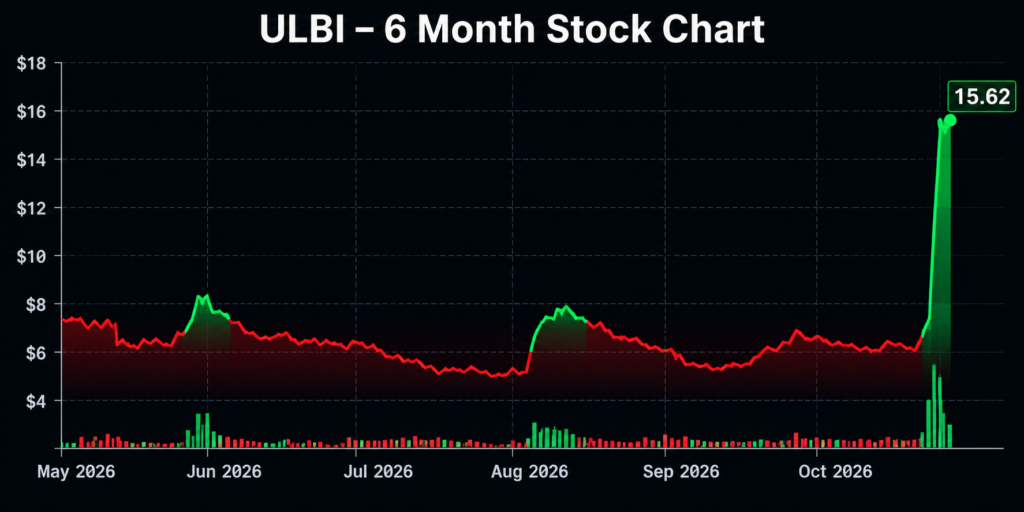
Ultralife Corporation (NASDAQ: ULBI) recently attracted considerable attention after its stock experienced a dramatic increase in value. The company operates in two important areas: specialized battery technology and communications systems.
Its products serve commercial, industrial, medical and government customers, including defense applications. As demand grows for advanced battery systems, military equipment, drones and other specialized technologies, Ultralife operates in markets that could offer meaningful long-term opportunities.
But investors have to consider an important development that changes the investment outlook considerably.
The $16-per-share acquisition offer
On October 27, 2026, EnerSys (NYSE: ENS) announced a definitive agreement to acquire Ultralife in an all-cash transaction valued at approximately $320 million, including assumed net debt.
Under the agreement, Ultralife shareholders are to receive $16.00 per share in cash.
The offer represented a 166% premium over Ultralife’s October 26 closing price of $6.01.
The transaction has been approved unanimously by both companies’ boards. EnerSys plans to finance the acquisition with cash on hand, meaning the agreement does not have a financing contingency.
The transaction is expected to close in the first quarter of 2027, subject to customary closing conditions, including regulatory approvals and a successful tender of at least a majority of Ultralife’s outstanding shares.
Ultralife’s board has recommended that shareholders accept the offer.
This is a significant development. It suggests that the company’s board believes the proposed acquisition provides shareholders with an attractive outcome compared with continuing as an independent company.
What makes Ultralife an interesting business?
The acquisition announcement shouldn’t overshadow the underlying company.
Ultralife manufactures specialized battery products and energy systems used in applications where reliability and performance are important.
Its markets include:
- Military and defense battery systems.
- Communications equipment.
- Medical battery applications.
- Industrial and commercial energy products.
- Emerging defense drone and counter-drone applications.
These are important markets, particularly as governments and defense contractors continue investing in advanced technology and military capabilities.
EnerSys has indicated that acquiring Ultralife will expand its capabilities in mission-critical defense applications, including drones, counter-drone systems and soldier power.
This strategic fit helps explain why a much larger energy-storage company is willing to pay a substantial premium.
Examining Ultralife’s financial performance
The company’s second-quarter 2026 results provide a useful look at its financial condition before the acquisition announcement.
For the quarter ended June 30, 2026:
| Financial measure | Q2 2026 |
|---|---|
| Revenue | $47.9 million |
| Gross profit | $13.9 million |
| Gross margin | 28.9% |
| Operating income | $3.4 million |
| Earnings per share | $0.15 |
| Adjusted EBITDA | $6.1 million |
| Backlog | $117.5 million |
Revenue was slightly lower than the same quarter in 2025, when the company reported $48.6 million.
However, gross profit and operating income improved. The company also reported a record backlog of $117.5 million.
One qualification is important: the reported gross margin benefited from a $1.1 million tariff refund. Excluding that refund, gross margin was approximately 26.6%.
Ultralife also reported approximately $6.7 million in cash and $44.6 million in total current and long-term debt at June 30, 2026.
These numbers suggest a real operating business with customers, products and an established market presence, but not one without financial challenges.
Is ULBI still a good investment?
This is where investors need to be particularly careful.
Before the acquisition announcement, an investor might have considered Ultralife based on its battery technology, defense exposure, potential growth and improving profitability.
Now, the investment thesis has changed.
The $16-per-share cash offer establishes a proposed acquisition value, but it does not guarantee that the transaction will close.
An investor purchasing ULBI today is largely making a bet that the acquisition will be completed under the announced terms.
There are several considerations:
1. Acquisition completion risk
The transaction still requires the necessary shareholder tenders and regulatory approvals. Although the deal has substantial support, it is not yet completed.
2. Limited upside
If the stock is already trading close to $16, the potential gain from purchasing shares may be relatively small compared with the capital committed.
3. Downside if the transaction fails
If the acquisition falls apart, the stock could lose a substantial amount of its acquisition-related premium. Its October 26 closing price was only $6.01, although that historical price should not be treated as a guaranteed downside target.
4. Loss of independent-company growth potential
If the acquisition closes, Ultralife shareholders receive cash rather than continuing to own an independent publicly traded Ultralife business.
What about EnerSys?
EnerSys is a much larger company operating in stored energy solutions for industrial, infrastructure and defense markets.
The acquisition would expand EnerSys’ specialized battery technology and strengthen its position in defense-related applications.
EnerSys expects the transaction to become accretive to adjusted diluted earnings per share within approximately 18 months after closing, excluding transaction and integration costs and other non-recurring items.
For investors interested in the long-term battery and defense technology opportunity, EnerSys may be worth researching separately as a potential way to participate in that market after the Ultralife transaction.
QuotePal’s investment perspective
Ultralife is an interesting company with established products, specialized battery technology and exposure to markets that could experience continued demand.
Its improving gross profit, operating income and record backlog make the underlying business worth examining.
However, we have to separate the quality of the business from the attractiveness of its stock at today’s price.
The $16 acquisition offer fundamentally changes the investment proposition. This is no longer simply a question of whether Ultralife can grow its earnings over the next three to five years. It is also a question of whether an investor can purchase shares at a price that offers an attractive return before the acquisition closes.
Our preliminary assessment: Ultralife is an interesting underlying business, but we would be cautious about chasing the stock following its dramatic appreciation. At this stage, the acquisition terms, current share price and likelihood of closing matter more than the company’s long-term independent growth prospects.
For investors looking for a long-term battery and defense technology investment, it may be worthwhile to examine EnerSys as well.
The best investment isn’t necessarily the stock that has gone up the most. It’s the company whose business prospects and valuation justify the price investors are being asked to pay.
Investment Disclaimer
This article is for informational and educational purposes only and should not be considered financial, investment, tax or legal advice. QuotePal.com is not a registered investment adviser, broker-dealer or financial planner.
The information presented is based on publicly available company announcements and financial reports believed to be reliable at the time of publication. Figures, acquisition terms and market conditions may change.
Investing in individual stocks involves risk, including the possible loss of principal. Merger and acquisition transactions are subject to conditions and may not close as expected. A failed transaction could result in substantial losses for investors purchasing shares based on an announced acquisition price.
Readers should conduct their own research and consult a qualified financial professional before making investment decisions.
Research before you invest.