From the QuotePal.com Desk
October 30, 2026
Investors looking for the market’s biggest opportunities in 2026 have seen some impressive returns, particularly in the semiconductor sector. But as the market continues to change, an important question remains: Are the best-performing investments also the safest?
The answer is no. Strong returns can come with substantial risks, and investors should look beyond the latest performance numbers before deciding where to put their money.
Semiconductor ETFs are leading the performance race
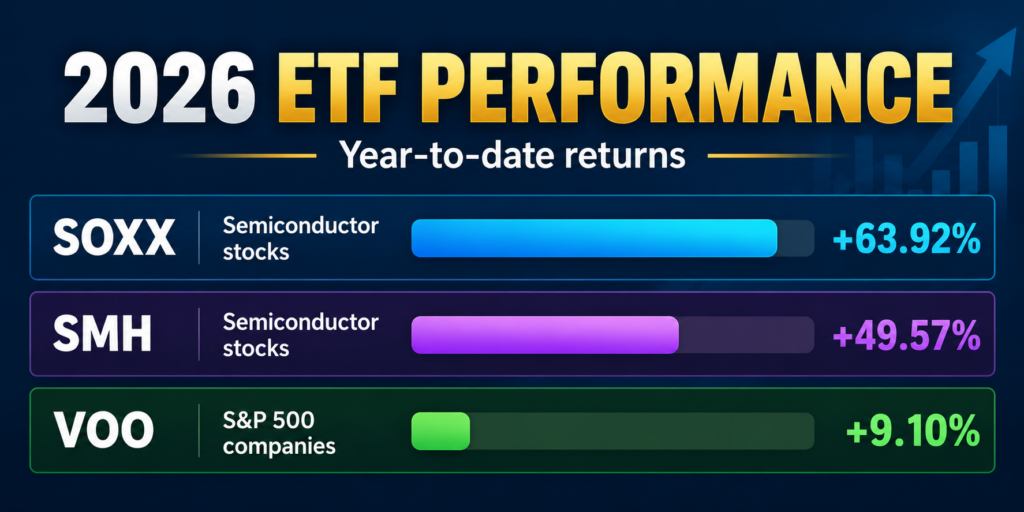
As of October 29, 2026, several popular ETFs have delivered strong year-to-date results:
| ETF | Investment focus | 2026 YTD return |
|---|---|---|
| SOXX | Semiconductor stocks | +63.92% |
| SMH | Semiconductor stocks | +49.57% |
| VOO | S&P 500 companies | +9.10% |
Source: Total Real Returns, October 29, 2026. Returns include reinvested dividends.
The semiconductor sector has benefited from continued interest in artificial intelligence, data centers, advanced computing and the companies supplying the technology behind those industries.
SOXX and SMH: Impressive growth, higher risk
The iShares Semiconductor ETF (SOXX) and VanEck Semiconductor ETF (SMH) have been among the strongest performers in this comparison.
Both funds provide exposure to major semiconductor businesses, including companies involved in chip design, manufacturing and equipment.
However, investors should understand that these funds are concentrated in one industry. A slowdown in semiconductor demand, weaker technology spending or disappointing earnings could cause significant declines.
Their recent returns are impressive, but they should not automatically be considered safe investments.
VOO: A more diversified approach
The Vanguard S&P 500 ETF (VOO) takes a different approach. Instead of concentrating on semiconductors, it invests in approximately 500 leading U.S. companies across multiple industries.
Its performance has been lower than the semiconductor ETFs in 2026, but its broader diversification makes it a different kind of investment.
For investors seeking long-term stock market exposure without concentrating their entire investment in one industry, a broad-market ETF deserves consideration.
What about the highest returns?
Commodity funds, including oil-related ETFs, can sometimes produce extraordinary returns when energy prices move sharply. But these investments have different risks from traditional stock ETFs.
Some commodity funds use futures contracts, which can behave differently from simply owning shares in companies. They may also experience substantial volatility.
A spectacular return over several months does not necessarily make an investment suitable for a long-term portfolio.
Which investment offers the best balance?
There is no single ETF that is simultaneously the highest-returning and safest investment.
Investors should consider several factors:
- Historical performance: How has the investment performed over one, three, five and ten years?
- Volatility: How sharply does its price move?
- Maximum drawdown: How much has it fallen from previous highs?
- Diversification: Is the fund concentrated in one industry or spread across the market?
- Expenses: How much does the fund charge investors annually?
- Investment objective: Is the goal growth, income, capital preservation or a combination?
For investors who want broad stock market exposure, VOO and VTI are worth comparing. Those seeking greater exposure to the semiconductor industry may want to research SOXX and SMH, while recognizing their higher concentration risk.
The QuotePal takeaway
The biggest investment winner today may not be tomorrow’s winner. Rather than chasing whichever ETF has the highest recent return, investors should consider how much risk they are taking to achieve those gains.
A balanced investment strategy should account for growth potential, diversification, volatility and the investor’s time horizon.
At QuotePal, our goal is to help investors look beyond the headlines and make better-informed investment decisions.
Investment Disclaimer: This article is for informational and educational purposes only and should not be considered financial, investment or tax advice. Past performance does not guarantee future results. ETFs and stocks can lose value, including the loss of principal. Investors should research each investment and consider their individual financial circumstances and risk tolerance before making investment decisions.