From the Quotepal.com Desk
October 24, 2026 | Stock Analysis: Moderna (NASDAQ: MRNA)
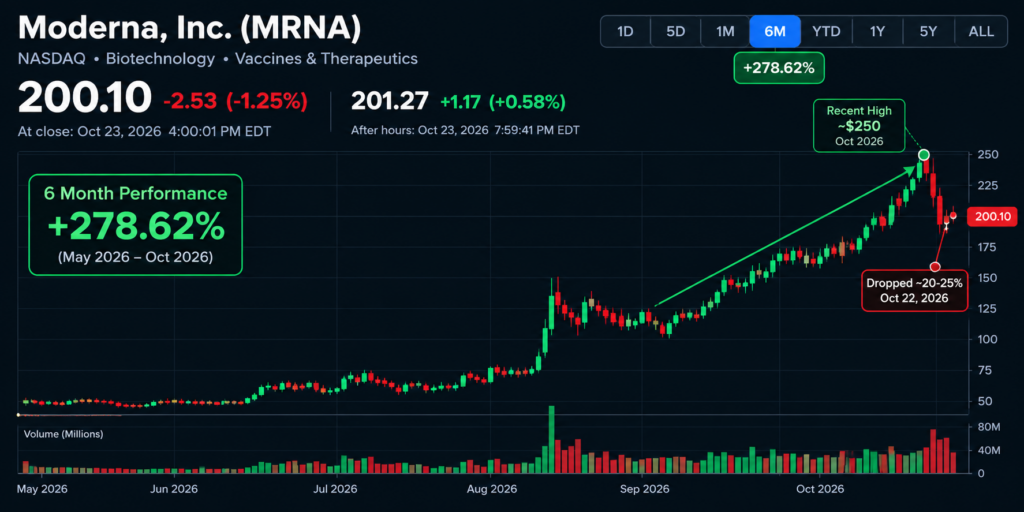
Moderna has become one of the most closely watched biotechnology stocks of 2026. After a remarkable rally fueled by optimism surrounding its cancer-vaccine research, the stock suffered a dramatic setback this week. Shares plunged approximately 25% on Thursday, October 22, raising an important question for investors: Is this a buying opportunity, or a warning that expectations have gotten too far ahead of the business?
The answer may depend on how investors evaluate Moderna’s promising medical research, its future revenue potential, and the risks that remain.
What caused Moderna’s huge rally?
Moderna’s stock has experienced extraordinary gains in 2026, with one market-data source reporting a six-month return of approximately 278.62%. Actual performance figures can differ depending on the measurement dates and data provider.
A major catalyst has been the company’s personalized mRNA cancer-vaccine program, developed in partnership with pharmaceutical giant Merck.
On August 19, Moderna and Merck announced positive results from a Phase 3 clinical trial evaluating their experimental cancer treatment, intismeran autogene, also known as V940 or mRNA-4157, in combination with Merck’s Keytruda immunotherapy.
The treatment is designed to help a patient’s immune system recognize mutations specific to that person’s tumor. Unlike a conventional preventive vaccine, this experimental therapy is intended to help fight cancer after a tumor has been diagnosed and surgically removed.
The concept is exciting because it could potentially open new avenues for personalized cancer treatment.
The cancer-vaccine results: Why investors are watching
The Phase 3 INTerpath-001 trial enrolled 1,137 patients with high-risk melanoma whose tumors had been surgically removed.
The combination of Moderna’s investigational vaccine and Keytruda produced encouraging results compared with Keytruda alone:
- 42% lower relative risk of cancer recurrence or death.
- 38% lower relative risk of distant metastasis or death, meaning the cancer spreading to distant parts of the body or death.
- The two-year recurrence-free survival rate was 82.2% in the combination-treatment group, compared with 70.0% in the Keytruda-only group.
These findings are significant, but investors should understand that a reduction in relative risk is not the same as a 42-percentage-point improvement in survival. Overall-survival data are not yet mature, and additional follow-up will be needed.
The companies are engaging with regulators regarding potential submissions. The treatment remains investigational, and regulatory approval and commercial success are not guaranteed.
Nevertheless, the trial represents an important milestone for personalized mRNA cancer therapy.
Why did Moderna stock fall so sharply?
The surprising part of this week’s selloff is that the detailed trial results were positive.
On October 22, shares fell approximately 25% after detailed Phase 3 results became public ahead of their planned presentation at a medical conference.
Several factors may help explain the decline:
1. Investors had already priced in enormous expectations.
After a tremendous rally, even positive results can disappoint investors if they are not quite as strong as the market had anticipated. Some investors may have decided to take profits rather than wait for the next catalyst.
2. The detailed results raised additional questions.
Although the Phase 3 trial met its important endpoints, some investors were comparing the results with earlier Phase 2 findings. Comparisons between separate trials must be treated cautiously because patient populations, follow-up periods, and study designs can differ.
3. The company’s future remains uncertain.
Moderna still faces the challenge of replacing revenue lost as COVID-19 vaccine sales declined. A successful cancer-treatment program could eventually become an important new business, but development, regulatory review, manufacturing, reimbursement, and commercialization all take time.
The sharp drop therefore appears to reflect a reassessment of expectations and valuation rather than a failure of the Phase 3 trial.
Is Moderna a buy after the decline?
For investors considering a position, the recent pullback may offer a more attractive entry price than buying near the stock’s recent highs. However, a steep decline does not automatically make a stock undervalued.
There are two sides to the investment case.
The bullish case
- Positive Phase 3 cancer-vaccine results could strengthen the company’s long-term research and commercial prospects.
- The personalized mRNA platform may have applications beyond melanoma, although additional studies are needed to establish its effectiveness in other cancers.
- A successful launch could provide a potential new source of revenue beyond COVID-19 vaccines.
- A substantial correction may create an opportunity for investors who believe the market has overreacted.
The bearish case
- The stock has already experienced a tremendous rally, increasing the risk of further profit-taking and volatility.
- The cancer vaccine has not yet received approval, and its eventual commercial contribution remains uncertain.
- Declining COVID-19 vaccine sales and the cost of developing new products remain important financial considerations.
- Positive trial results do not guarantee that the stock will recover quickly or that today’s price represents fair value.
What should investors watch next?
Before buying Moderna, investors should monitor several developments:
- Regulatory progress: Watch for announcements about submissions, review timelines, and potential approval of the personalized cancer treatment.
- Additional clinical data: Longer follow-up will help clarify whether the treatment delivers durable benefits, including its effect on overall survival.
- Financial results: Examine revenue trends, cash reserves, operating expenses, and management’s outlook for reaching sustainable profitability.
- Stock-price behavior: After a sharp selloff, investors may want to see whether the shares stabilize rather than assume the first decline represents the bottom.
- Valuation: Compare the company’s market value with its current business, financial resources, and realistic future revenue potential—not just its most optimistic possibilities.
Investors should also remember that a promising cancer treatment could take years to translate into substantial revenue.
The Quotepal.com takeaway
Moderna’s recent decline presents an intriguing situation for investors. The company has produced encouraging late-stage clinical results for a personalized cancer vaccine, yet its stock has fallen sharply after an extraordinary rally.
For long-term investors comfortable with biotechnology risk, the pullback may justify a closer examination of the company. For more conservative investors, waiting for additional financial evidence, regulatory progress, and greater stability in the share price may be more appropriate.
Rather than trying to predict whether Moderna will rebound next week, investors should focus on whether the company’s future prospects justify the price they are paying today.
A promising medical breakthrough can create a major business opportunity, but the best investment decisions still require careful research, realistic expectations, and an understanding of the risks.
Sources for further reading: Moderna’s Phase 3 trial announcement, Reuters coverage of the October 22 selloff.
Disclaimer: This article is for informational and educational purposes only and does not constitute financial or investment advice. Stock prices can be volatile, and investing involves the risk of losing money. Clinical-trial results do not guarantee regulatory approval or commercial success. Always conduct your own research and consider your financial circumstances before making investment decisions.